
How to get out of the freeze response (When the tips and tricks don’t work).
Read me in 5 minutes, 18 seconds
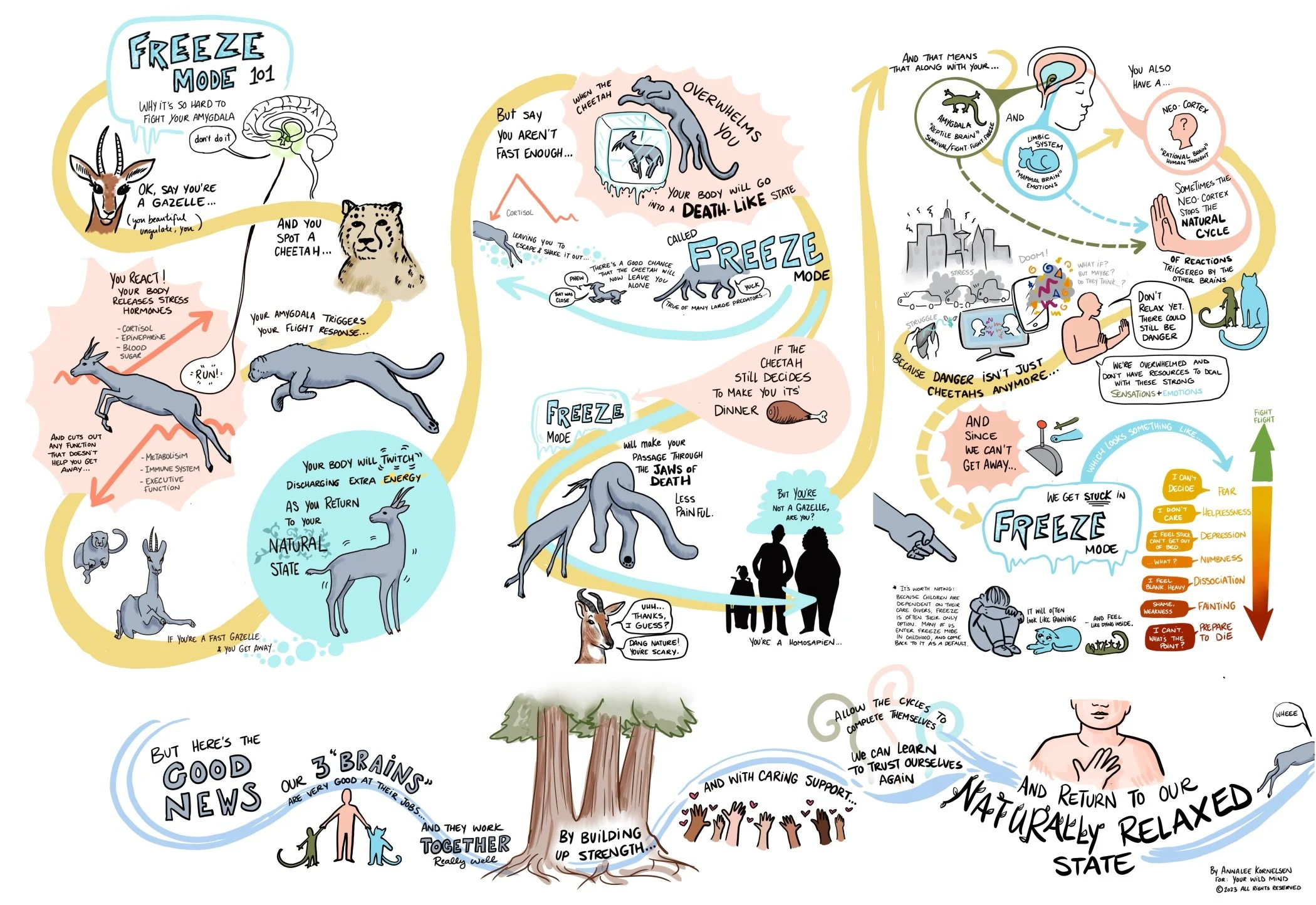
If you’ve been on social media lately, you might have run in to terms like “Freeze mode” and “functional freeze”. If you want a refresher on what it is and how it works, I’ve made you this handy infographic. Read on or skip ahead to the “how to” bit.
Ok, so now that we know what it is, how do we get out?
The quick answer: we need to mobilize.
If you think of the nervous system as a ladder (or look at the red arrow in the infographic) freeze is at the bottom. In order to get out of the immobilization of freeze and climb the ladder back up to relaxation, we have to pass through the mobilization states of fight and flight, in that order. We unfreeze, we fight back, we get away, and we relax.
Mobilizing “fight” energy can look like:
pushing your pack against a wall as hard as you can
clenching and releasing all of your muscles while imagining winning a battle
boxing, wrestling, and other martial arts
thrash dancing to a loud song you love
screaming into a pillow
Mobilizing flight energy could mean:
going for a run, a fast walk, bike ride or even a drive (but safely)
trembling and shaking exercises
changing locations
finding a moment of privacy (like stepping outside or into another room)
This is called “completing the stress cycle” and there are a bunch more ways to do it. Somatic exercise, breath work, tapping exercises… the list goes on.
The trouble is that it’s very difficult to go from freeze right into mobilization.
Mainly because we DON’T WANT TO. If we’re stuck in freeze, we usually have a very good reason to be there. It usually means there is something that our system is interpreting as danger. It feels like freezing is the best way to stay safe. Because the stressors we’re responding to these days are so much more complex than cheetahs, it’s hard to tell when we’re safe and when we can and should relax. We might be able to see that we’re stuck, or numb, but it feels impossible to do anything about it.

Fight or flight are fairly straightforward. Energy that is set in motion needs to be felt and released. Freeze mode, however, only wants the pain to stop. It has no goal or agenda other than “no please”. Treating it is like treating frost bite. It’s delicate. If you warm someone up too fast, it can backfire.
It’s a good idea to seek out trauma informed therapy and safe relationships. Tools like EMDR, Somatic Experiencing, and Brainspotting are very good at breaking the ice of Freeze mode. The most effective modality for gently thawing that I’ve ever tried is called DBR Therapy, or Deep Brain Reorienting.
But even with amazing support, most of the work of healing from trauma and easing our way out of freeze mode happens in the day to day of our relationships. Building strength and widening our window of tolerance is a long process that involves setbacks. There is no way to make life so safe that you will never move through your survival modes. The trick is building the capacity to start moving up and down that ladder in a healthy way, and getting used to finding your way tback to relaxation.
So what do you do when you just can’t make yourself go for a walk or do the effing breathing exercise?
What do we do when the mobilization tips and tricks don’t work:
Step 1: Stop
I know, you already feel motionless. But shock and freeze energy needs the very slow warmth of your attention to thaw. If you’re too stuck to get unstuck, I want you to stop pushing yourself, and slow… all… the way… down. Notice the stuck-ness and just sit next to it. Don’t try and change it just yet. Keep doing what feels safe, just for now.
Step 2: Observe
What can I feel, if anything? What part of my body feels ok right now? We’re not trying to unpack any feelings; we’re looking for a glimmer of safety.
Step 3: Locate and adjust an on-ramp
If a long fast walk feels impossible, what about a short slow one? No? What about standing up for a moment and doing one stretch? Still to steep? Try moving your head or eyes side to side. Wiggling or rubbing your toes. Still can’t reach the first rung of the ladder? Try going sideways. If you can’t stop binging, law and order, try a less violent and triggering mystery series? Doom-scrolling on the internet? Switch to some more lighthearted content. Click on the first funny or uplifting account and scroll there instead of your feed. How slowly and gently do you need to move for it to feel safe?
Step 4: Be mentally prepared
Once you start moving out of Freeze, you’re going to go up the ladder through the other states too. What tools, supports and support can you reach for to help you move through all the feelings that were under the ice you’re thawing? Do you need to reach or a pet? Call a friend? Book a session with your therapist or favourite energy worker? Maybe you have an expressive hobby that gets the energy moving. Once you start to thaw, that’s when those tricks for completing the stress cycle come in handy. (See above).
Working with trauma is about introducing more choice
This is about easing back into our agency a little bit at a time. Remembering our natural curiosity and adjusting the things we do so that they actually meet our needs. It doesn’t have to be fancy. It just has to work. We work through trauma in layers and cycles, and new stressors are coming at us all the time. Backing ourselves into a corner or trying to force change usually makes it worse.
If you find yourself always getting stuck at the same places in your growth, and trying to push through just makes it worse, working with a trauma-informed coach or therapist can help. I help my clients navigate their nervous systems as they move towards their goals so that they can make changes in a way that doesn’t cause them to shut down.
if that sounds good to you you can,
XO Annalee
If you liked the infographic and want to take it home, put it up in your office/clinic or hand it out to your clients you can purchase posters, hsnadouts and printable downloads here.