
Why rest alone doesn’t fix burnout
Read me in: 3:16 min
Rest is vital for burnout recovery, and it’s only part of the solution.
If we rest and recover, but then go back to the exact same life that burned us out in the first place, then what we’re really doing is creating a cycle. A pattern where we go from burnout to burnout. Fill and empty. Fill and empty.
If you’re reading this you probably understand what I mean on a gut level because one of the big signs of burnout is a feeling of “I just can’t go on. I can’t do this anymore”. Your body knows. Your system knows. Something needs to change. The challenge is figuring out what, exactly, needs to change, and how to change it without causing more burnout (because change is hard and takes energy).
This is the work I do with my clients, and it’s a lot like restoring an ecosystem. There are stages to burnout recovery which each come with their own landscapes, insights and challenges. And, because everything in ecosystems is a circle, these stages overlap, iterate and happen in layers. Here’s a visual of how I think about it.
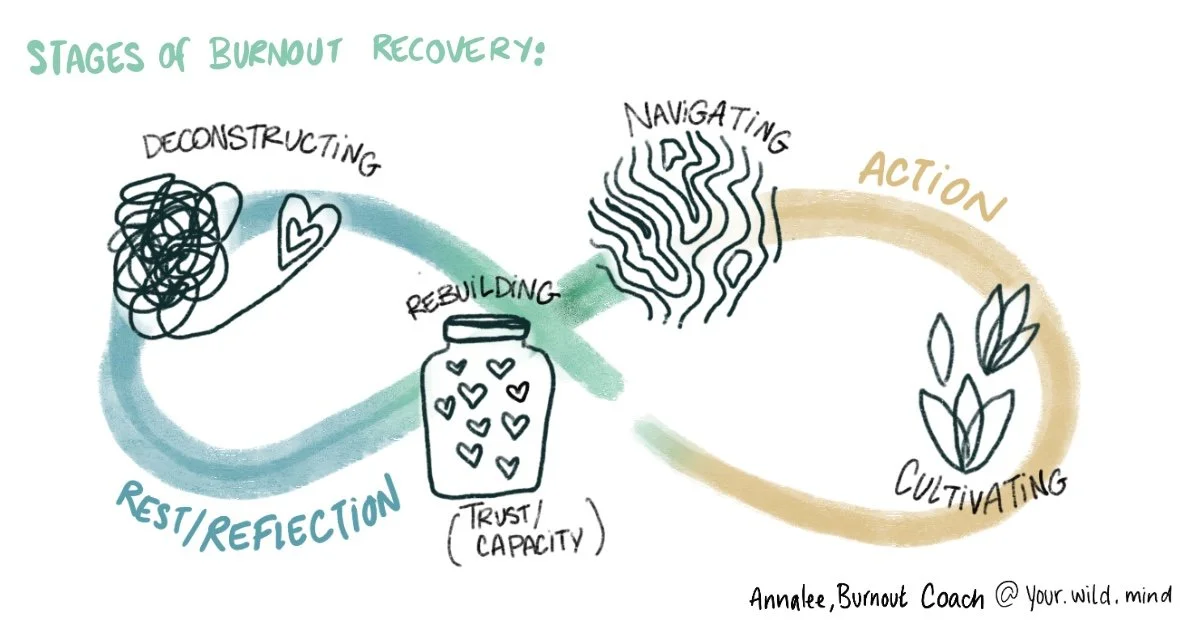
A lot of conventional advice about burnout falls flat because it focuses only on increasing capacity through rest, which is important. In fact, it’s step 1! The Initial rest allows for everything else to take place. But like any type of healing in the body, rest becomes active rest that then becomes strengthening. That in turn shifts into a natural cycle of rest and exertion. That’s the system we’re working to restore in burnout recovery (well, one of the systems.)
Burnout doesn’t only come from over-work or exertion. There’s sensory overwhelm burnout, caregiving burnout, misalignment burnout (aka: moral injury), under-use burnout (bore-out) and more. And you can experience more than one kind at once. Ultimately each one stems from some sort of imbalance. The solutions to your burnout pattern will be as unique as you are. In my experience, exiting the burnout cycle requires us to move through:
Deconstructing the lessons we’ve learned from systems, institutions, and people who’ve claimed agency over how we use our time, bodies and expression.
Rebuilding our capacity to learn, effort, create and rest; and our trust in that capacity.
Navigating how we actually move through the world and interact with it and its challenges.
Cultivating the interests, systems, boundaries, and natural motivation that works best for us.
And as we do so, we each get to solve the puzzle of our unique burnout experience. With my clients, I always try to zoom out and see the larger patterns there. For example, maybe it’s less about not exerting yourself and more about expressing yourself more. But we work on the little stuff that adds up. Maybe we find you a bunch of smaller wins that lead to big reductions in your mental load (like, did you know you don’t have to fold workout clothes? At one time, I sure didn’t). But most importantly, we tackle the complexity of living as you in a world made both of magic and wonder, and exploitative systems. And we work to put as much of the agency, and creative control over your life back in your hands.
If this resonates, the burnout coaching page is a good place to learn more.
How to navigate the 4 stages:
These 4 stages contain little bits of all the others. There isn’t a strict line drawn between them. When you start navigating the world, for example, you’re bound to run into some new layers of deconstruction you couldn’t have anticipated. It happens to me all the time. But where you are starting from, and your capacity and focus as they are right now, will usually inform the work we do and the way we do it. For example, someone feeling deeply depleted doesn’t have the energy to start a brand new business that runs in a completely new way from what they had learned in corporate. Because of those differences, I’ve tailored my coaching approach to 4 different approaches.
1) Rich Soil: this is for those feeling deeply depleted. At this stage it’s about triage, finding ways to pull energy back in to your system, and deconstructing the lessons and coping strategies that once helped you survive but are now draining your resources.
2) The Greenhouse: for the stage of burnout recovery where the work turns into creative play. We build trust in our capacity through low/no expectation exploration. There’s usually some deconstructing to do about the inner critic and perfectionism, but I believe that can be done gently without rejecting any part of ourselves.
3) The Kitchen Garden: this is when we leave the cocoon of recovery and no pressure exploration and start to interface with the big, wide world. Often this looks like community, projects, or work. I work mostly with new business owners at this stage. Burnout is often the turning point before a transition into self-directedness and I love to help folks build a bridge between their employee and entrepreneur selves.
4) Tend the Orchard: When we’ve built something that takes on a life of it’s own: our lives’ ecosystems, our projects. How do we cultivate and steward them with care? With respect for their complexity? How do we problem solve without burning the whole thing down? That is the work (and playful exploration) of our life times. And these are the questions I work on with my retainer clients. Some of them for years.
Wherever you are on the journey, I hope you find what you need. And if what you need is a hand to hold, mine is open and stretched towards you.